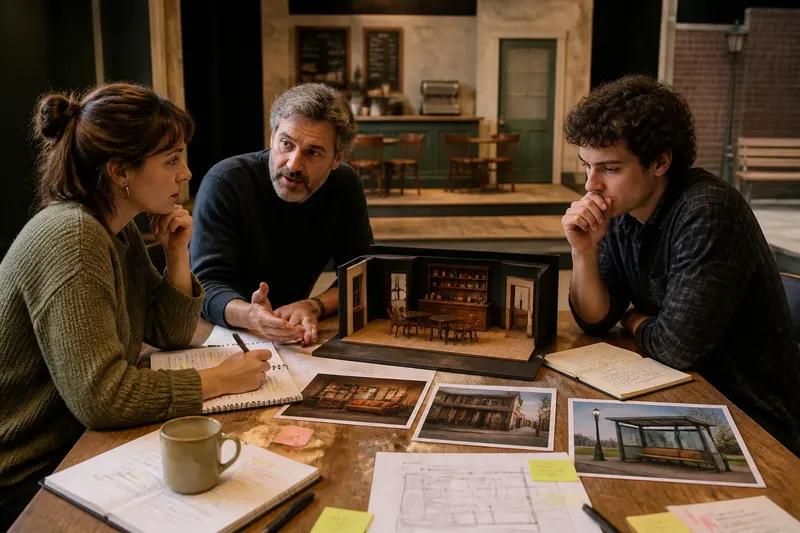
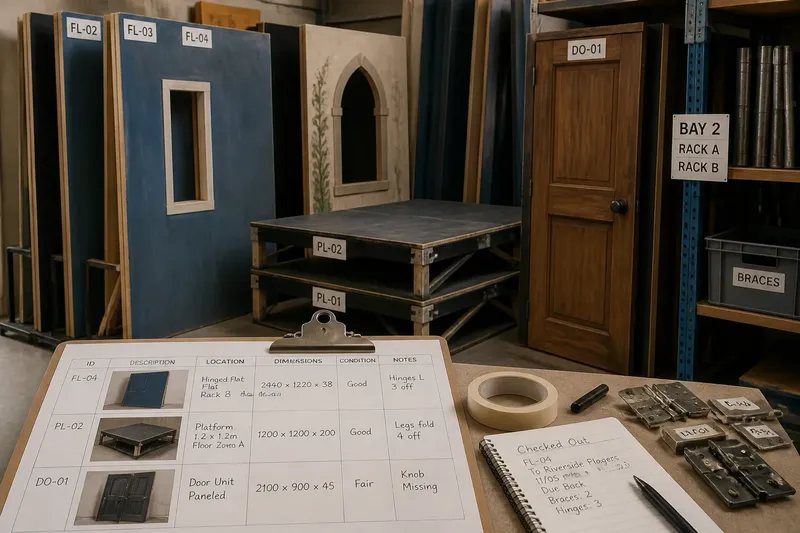
Why a Rehearsal Room Needs a Clear Centre
A clear centre in the rehearsal room gives blocking a shared reference point, so performers can move between scenes without repeatedly shifting chairs and tables.
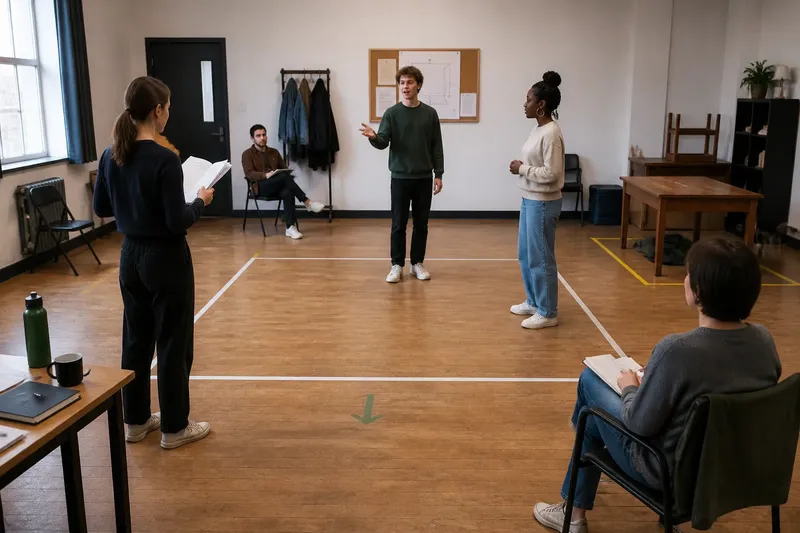
The common mistake in a rehearsal room is to let the furniture decide where the acting happens. A table drifts into the middle, chairs gather around it, and the next scene begins with everyone shifting the room before anyone can shift the story. Agreeing on a clear centre for the rehearsal room gives the cast a shared reference point, cuts down those resets and makes blocking notes easier to understand.
“Centre” need not mean the geometric middle of the floor. It means the part of the room that stands for the principal playing area, with a consistent relationship to the audience side. The useful question is not where the room’s centre lies, but which arrangement lets people rehearse the play without repeatedly negotiating where the stage is.
What does a clear centre actually mean?
Choose a recognisable acting area and keep its orientation stable. Mark the audience side, the main entrance and the edges of the playing space using features already in the room: a door, a window, a radiator or a particular wall. If those features are unreliable, use masking tape on the floor, provided the venue permits it and the surface is suitable.
Then give the cast simple names for the area and its directions. “Audience side”, “upstage wall” and “stage left” are useful only if everyone knows which way they point. In a room without a conventional stage, the director can establish a fixed audience side and explain the orientation before the first blocking note. A diagram on the callboard can help late arrivals; a small sketch is often clearer than a paragraph of directional lore.
The centre is a reference, not a claim that every scene must happen in the same spot. A scene can move to one side, use a doorway or leave the playing area open. The point is that the cast knows where the shared reference remains while the scene changes around it.
Should the room stay open or hold a fixed layout?
There are three common approaches. None is best for every group; the choice depends on the room, the script and how much of each rehearsal is spent moving objects rather than rehearsing.
Keep the playing area open
In an open-room approach, chairs, tables and spare props stay at the edges unless a scene needs them. The acting area remains visible and largely clear, with the audience side and entrances established in advance. This suits a small cast, a room used by several groups, or a production whose scenes move between locations without requiring a full furniture arrangement each time.
Its strength is flexibility. Performers can practise entrances, crossings and group compositions without walking round a permanent obstacle. Its weakness is that a bare room may not resemble the eventual stage closely enough for furniture-dependent scenes. A doorway, stair or platform that will matter later cannot be wished into place by good intentions.
Keep a fixed rehearsal layout
A fixed layout leaves selected furniture in consistent positions: perhaps a table against one wall, a row of chairs at the back and a clear central lane. This can suit a play with recurring furniture, a group that needs to rehearse around limited space, or a room where resets are difficult. It also gives performers stable landmarks for repeated movement.
The cost is reduced flexibility. An arrangement that helps one scene can obstruct another, and actors may learn to rely on furniture that will not be present in performance. Fixed positions need to represent a deliberate rehearsal choice, not the slow accumulation of objects no one has had time to put away.
Use a hybrid layout
A hybrid keeps the centre and audience orientation fixed while allowing a small number of movable pieces to come in for particular scenes. A marked parking area at the edge of the room keeps those pieces out of the playing space until needed. This suits scripts with a recurring central area but occasional furniture changes, and groups that want some realism without rebuilding the room between every scene.
The hybrid asks for clear conventions: who moves each item, where it waits and when the scene is considered ready. Without them, “flexible” can become a polite name for several people searching for the same chair.
Which approach suits your rehearsal?
Choose by looking at the demands of the work and the limits of the room, rather than by copying a professional theatre arrangement. A useful comparison is:
- Open room: best when scenes shift location and movement needs space; less suited to repeated business with specific furniture.
- Fixed layout: best when the same pieces recur and stable landmarks help the cast; less suited to scenes that need different spatial arrangements.
- Hybrid layout: best when most scenes share an acting area but a few require movable pieces; it needs agreed storage and reset responsibilities.
Check what the performance space will actually provide. If the final staging is unknown, rehearse the relationships that matter rather than pretending the rehearsal room is a miniature of a future venue. If the show will use a table, for example, a table of roughly similar scale may help with spacing, but the cast can still establish the centre and entrances before the exact furniture arrives.
Imagine a group rehearsing a play that returns to a kitchen but also includes scenes elsewhere. They agree that the audience side faces the long wall, keep the middle open, and place a table in a taped parking area when the kitchen scenes need it. The expected observable result is straightforward: actors can begin non-kitchen scenes without shifting the table, while kitchen blocking still has a consistent relationship to it.
One plain analogy helps: a clear centre is like the marked middle of a shared dining table. People can change seats or bring in a dish, but they do not need to renegotiate which end counts as the head at every meal.
How do you establish the centre without overplanning?
Set the convention during an early rehearsal, when the cast can try it rather than receive it as an abstract rule. Keep the decision modest. The aim is not to map every footstep before the actors have found the scene, but to prevent basic orientation from changing unnoticed.
- Choose the audience side. Name the wall or direction that represents the audience, even if the room is temporarily arranged in the round.
- Identify the main playing area. Use a visible floor boundary, a simple rectangle of tape or a clear description tied to fixed room features.
- Name the entrances. Refer to actual doors or agreed gaps, and distinguish them if more than one is in use.
- Agree the movement vocabulary. Confirm stage left, stage right, upstage and downstage from the performers’ point of view, or use plain room-based directions consistently.
- Decide where furniture waits. Keep scene-specific items outside the centre and name who brings them in and removes them.
- Record the arrangement. Draw a quick plan and note any changes on the rehearsal copy or callboard so an absent actor is not asked to infer the new geography.
These are decisions, not a safety procedure. Tape, furniture and room use should follow the venue’s instructions and the relevant local rules. If a doorway or route must remain clear, do not treat it as spare stage space.
What do actors and directors gain from the same reference?
For actors, a stable orientation makes blocking notes more usable. “Cross towards the audience-side chair” gives a repeatable destination if the chair and audience side have already been established. “Move over there” depends on the speaker pointing, the listener looking, and nobody confusing the gesture with a note about the previous scene.
For directors, a common centre separates a creative choice from a room-management problem. A director can ask whether a scene should feel crowded, exposed or divided without first clearing a path through unrelated furniture. The cast can then test the effect in the space the arrangement provides.
For stage managers and anyone helping with rehearsal, consistency also makes resets easier to call. If the table has a named parking position and a known entrance route, the instruction can be brief. If each person has a different idea of where “back” is, the reset becomes a small committee meeting with props.
What questions come up about a rehearsal room centre?
Does the centre have to be in the middle of the room?
No. It should be a stable, useful playing area, not a geometric requirement. A corner or one side may work better if it leaves entrances clear and gives performers enough room to move.
What if the performance venue has a different layout?
Keep the rehearsal vocabulary consistent, then adapt it during a venue walk-through or technical rehearsal. The acting relationships can transfer even when the room’s walls, audience position or entrances differ.
Should rehearsal furniture match the set?
Use representative pieces when their size or function affects movement, such as a table that performers circle or sit behind. For other scenes, empty chairs or clearly marked positions can stand in without requiring the full set in the room.
Can the playing area change between scenes?
Yes, if the change is deliberate and the cast knows what marks the new arrangement. Keep the underlying audience orientation stable unless the production specifically needs it to shift.
When is it time to revise the arrangement?
Revisit the room plan when the cast repeatedly collides with furniture, entrances are hard to see, or a blocking note works only from one person’s imagined map. Those are signs that the convention no longer serves the rehearsal, not evidence that the actors need a longer lecture on direction.
Make one adjustment at a time and tell the people affected. Moving the audience side, changing the parking place for props and altering the acting area all at once makes it hard to know which change helped. A brief note on the room plan preserves the new arrangement for the next rehearsal.
A clear centre is most useful when it stays ordinary: visible enough to orient the cast, flexible enough for the play, and unremarkable enough that rehearsals can get on with the scenes. For a rehearsal room clear centre, choose an arrangement the group can explain in a sentence and repeat without moving half the furniture first.