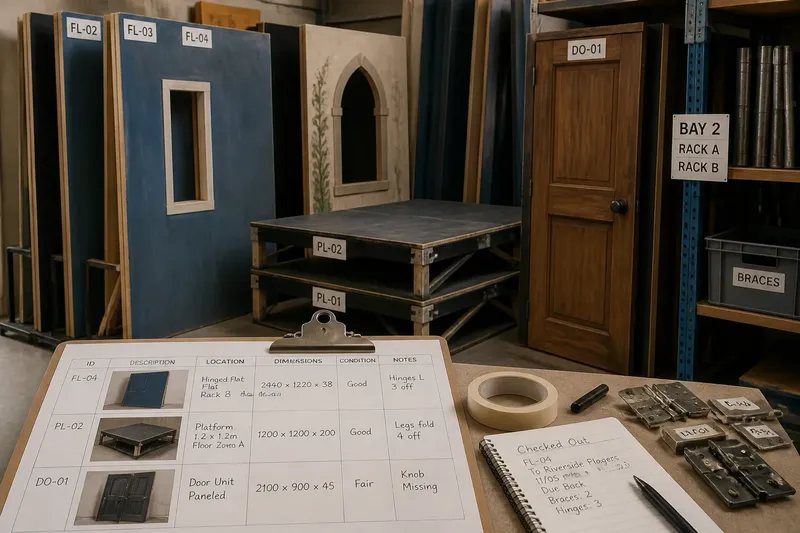
A Calm Pack-Away After the Final Bow
A calm pack-away after the final bow separates returns, reusable stock and worn-out materials, leaving your amateur production team with a clear inventory.
The common mistake after a final bow is to put everything into the nearest box and promise to sort it later. That turns a borrowed candlestick into an unlabelled mystery and leaves the next production guessing what is usable, what belongs elsewhere and what should not be kept.
A calm pack-away after the final bow is less about speed than making a clear decision for each item before it leaves the room. Work through the space in a fixed order, keep borrowed property separate from your own stock, and record the destination as you go. Think of it like clearing a kitchen after a shared meal: the useful thing is not merely an empty table, but knowing which cupboard each item belongs in.
What should be ready before the room is cleared?
Set aside a small sorting area near the exit, away from the main traffic route. Gather sturdy boxes, masking tape, marker pens, labels, a notebook or shared inventory file, and rubbish and recycling containers. Bring the production’s prop list, costume notes and any loan records; memory is a poor filing system once the cast has gone home.
Agree who is responsible for each kind of item. One person can check loans, another can record reusable stock, and a stage manager or producer can make decisions about uncertain pieces. If the group is small, do the same jobs in sequence rather than having everyone move everything at once.
- Make a labelled area for borrowed items awaiting return.
- Make a separate area for equipment and materials the group owns.
- Keep damaged or uncertain items apart until someone can assess them.
- Put cleaning materials and packing supplies where they can be reached without rummaging through props.
- Keep a clear route to the doors and any venue collection point.
Before sorting begins, check the venue’s close-down arrangements and any lender’s instructions. Follow those requirements where they apply; do not assume that a borrowed object can be cleaned, repaired or repacked in the same way as the group’s own property.
How should you sort the room in order?
Start with items that must leave the venue or go back to another owner. Work through the dressing room, backstage areas and performance space, checking shelves, prop tables, coat hooks and storage corners. Match each borrowed item to its owner or loan note. Pack it with any accessories that belong with it, and label the package with the destination and the person responsible for returning it.
Next, collect the production’s own equipment and reusable materials. Group objects by their next useful home, not simply by where they were found. Put hand props together, keep lighting or sound accessories with their labelled cases, and separate clean fabric from materials that need laundering or repair. A bundle of loose cables in a prop box may look tidy, but it is still in the wrong place.
Then review set pieces and consumables. Keep a useful offcut only if its material, condition and likely storage place are clear. Fold sound fabric, nest compatible containers, and store flat scenery so it is not bent or hidden behind heavier items. Put paint, adhesives and other workshop materials aside for a responsible person to check rather than casually combining or disposing of them.
Finish with the worn-out or unwanted material. Separate ordinary rubbish from recycling where the venue provides those options. If an item is damaged but might be repairable, mark the problem and leave it for a named person to decide; do not quietly return a faulty shared tool to its case. When a material’s disposal or handling is uncertain, follow its label and the relevant local arrangements.
What should the inventory record?
Record enough to help the next team identify the item and act on it. An inventory does not need to become a catalogue of every scrap of tape. It should answer: what is it, where is it now, what condition is it in, and what happens next?
- Item: use a plain description, such as “wooden café chair”, not “the chair from act two”.
- Quantity: record the number of matching pieces if there is more than one.
- Location: name the store, cupboard or labelled container.
- Condition: note clean, needs repair, incomplete or awaiting inspection.
- Action: record return, clean, mend, keep or dispose, with a responsible person where needed.
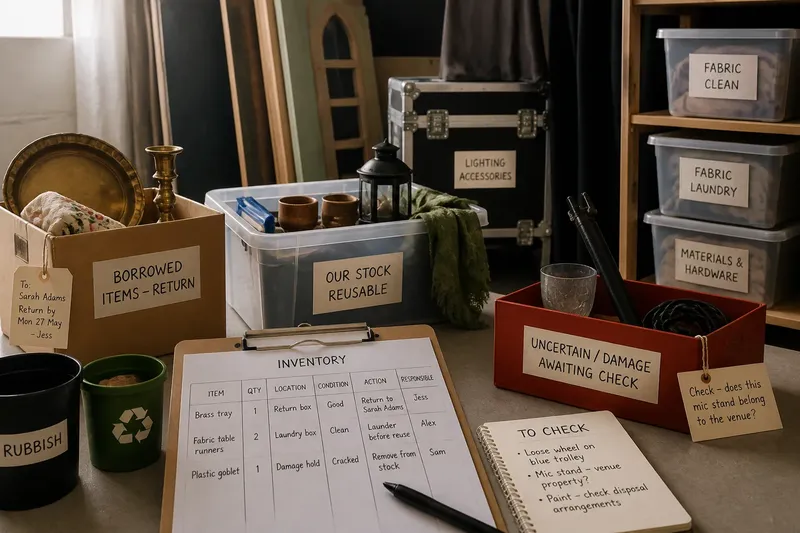
Say you have a borrowed brass tray, two fabric table runners and a cracked plastic goblet. The tray goes into a return box with its owner recorded; the runners are labelled for laundering before reuse; the goblet is marked damaged and removed from usable prop stock. The expected result is visible in the inventory: one return, one cleaning task and one item awaiting disposal, rather than three objects in an anonymous carton.
How do you handle uncertain or damaged items?
Do not let uncertainty spread through the whole pack-away. Put unresolved objects in one clearly marked holding area and write down what needs deciding. A note such as “check whether this microphone stand belongs to the venue” is more useful than “sort later”. Give the question to someone who can answer it and set a sensible point for resolving it before the space is used again.
For damaged reusable stock, describe the fault plainly. “Loose wheel on blue trolley” helps the next person inspect it; “broken” does not. Keep faulty equipment out of normal circulation until it has been assessed. Safety-critical repairs are for a suitably qualified person, not a well-meaning cast member with a screwdriver and a closing deadline.
For anything that is merely unattractive, distinguish appearance from function. Scuffed scenery flats or faded fabric may still be useful, while a pristine object with a missing fitting may not be ready to use. Record the condition honestly so the next production can decide without opening every box.
What questions come up during pack-away?
Should every leftover material be kept?
No. Keep items that have a clear use, suitable condition and known storage place. If nobody can identify the material or its likely use, label it for a decision rather than letting it become permanent store-room archaeology.
How should borrowed props be packed?
Keep them separate from owned stock, include their accessories and note the owner and return arrangement. A dedicated return box reduces the chance that a lender’s property is absorbed into the group’s general collection.
What belongs in the inventory?
Record items that will be reused, returned, repaired, cleaned or checked later. Focus on descriptions and actions that help another person locate and handle them; routine rubbish does not need a catalogue entry.
Who should close the inventory?
Name one person to check that every return and unresolved task has an owner. That person can mark the inventory complete once the room is clear and the remaining actions are recorded, without pretending that every repair has already been done.
How can the next project inherit a useful store?
Before leaving, compare the labelled containers with the inventory and check the places where small items tend to hide: drawer bottoms, costume pockets, backstage ledges and the space beneath prop tables. Make sure return boxes are not mixed with stock, and that the next person can find the file or notebook without asking who last had it.
Keep the final record brief enough to use. Note any storage change, outstanding return, repair decision or cleaning task, then share the location of that record with the production team. A calm pack-away after the final bow does not mean that every object is immaculate; it means the next project can tell what it has, what it owes, and what needs attention before anyone reaches for a mystery box.