From Stock Scenery to the Shared Set Box
A shared set box keeps amateur theatre scenery usable: find out how to label, store and maintain stock without turning every build into a hunt.
The common mistake with a shared set box is treating it as a place to put scenery nobody has time to sort. The cost arrives at the next build: a useful flat is buried, a borrowed platform has lost its fittings, and the group spends rehearsal time looking for a piece it already owns. Stock scenery becomes practical only when people can identify what is there and judge whether it suits the job.
Reusable scenery has long been a resource-minded answer to changing budgets and changing productions. Amateur groups inherit, borrow, adapt and build pieces that can serve again, but reuse does not happen by itself. A shared stock needs a modest system that preserves useful information as well as timber, fabric and paint.
Why does stock scenery become hard to use?
Scenery usually becomes unusable on paper before it becomes unusable in practice. A note saying “large wall” tells the next team little about its footprint, finish, weight or condition. A photograph without a name is scarcely better once the original builder has left.
There is also a difference between owning an object and having usable stock. A group may have a collection of flats, rostra, door units and practical furniture, yet still need to build from scratch if nobody knows where pieces are, what they can safely support, or how they connect. Stock is a working resource, not a museum of previous enthusiasm.
Think of it like a kitchen drawer: a drawer full of useful utensils is still inconvenient if every handle is tangled together and nobody can tell which tin opener works. The answer is not an elaborate inventory project. It is enough order to make the next decision easy.
What goes wrong when pieces have no clear identity?
A piece without a stable name acquires several. One person calls it “the blue flat”, another calls it “the library wall”, and a third remembers it as “the one with the window”. Search becomes a conversation about memory rather than a search of the stock.
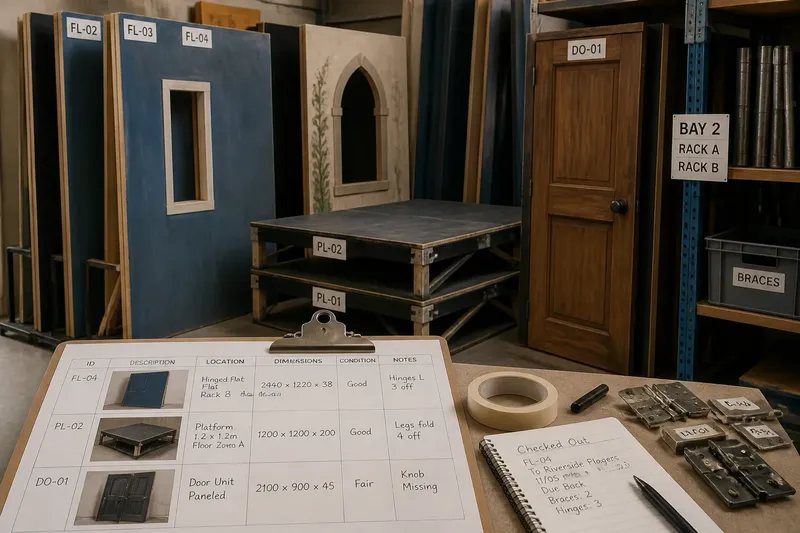
Give each reusable item a short, durable ID. A simple label such as FL-04 or PL-02 can be placed on a discreet, visible area, then matched to a record. Keep the ID when the paint changes or the piece moves to another storage bay. The description can change; the identity should not.
For larger stock, use a naming pattern that separates types: FL for flats, PL for platforms, DO for door units, and so on. Avoid encoding a production title or a current location into the ID. Both are likely to change, leaving the label out of date just when it is needed.
Say a group has three flats that all look like plain painted walls. It assigns each a distinct ID, then records one as hinged, one as a fixed panel and one as a lightweight scenic skin. When a director asks for a movable wall, the group can identify the relevant piece without pulling all three into the rehearsal room.
How can a group find pieces without a long search?
A location recorded as “in the store” is not a location. Make storage references specific enough to act on: a bay, rack, shelf or marked floor zone. Use the same terms on the stock list and on any signs in the store, so a volunteer does not need to translate between two private systems.
For each item, keep a compact record with:
- ID and plain description: name the object and the feature that distinguishes it.
- Storage location: give the bay, rack or other agreed place.
- Dimensions and handling notes: record the information needed to judge whether it can fit the venue and be moved by the group.
- Condition: note visible damage, missing parts or a finish that needs attention.
- Connections and accessories: list compatible braces, hinges, clamps or other stored components.
- Availability: record whether it is in the store, out on loan, reserved or awaiting repair.
Photographs help when they show the whole item and a useful detail, such as a hinge or connector. Save them under the ID rather than a production name. A shared spreadsheet, a printed catalogue by the store entrance, or both can work; the best option is the one the people handling the stock will actually update.
Why do apparently compatible pieces fail to fit?
“It worked last time” is not a specification. A flat may be a different height from its neighbour, a platform may have a surface finish that clashes with the intended floor, or a connector may belong to an older system. A photograph can make pieces look interchangeable when their backs tell another story.
Record the details that affect a production decision, not every detail that can be measured. For scenery, that may include overall size, whether a unit stands independently, its visible finish, how it joins to adjacent units and whether fittings are present. Note known limits plainly; do not rely on a builder’s memory being available at the next production meeting.
Before committing stock to a design, compare the record with the venue and the intended arrangement. A paper plan or a simple floor-tape outline can expose a mismatch before scenery is moved. Where an item is structural or otherwise safety-critical, do not infer suitability from a stock note or appearance; get an appropriate competent person to assess it.
Labels, manufacturer instructions and local rules govern questions of safe handling, loading, fire treatment and use. Keep those requirements attached to the relevant item or record rather than replacing them with informal assumptions.
What should happen when stock is borrowed or returned?
Scenery often leaves its usual home for a rehearsal, another venue or a partner group. Without a simple checkout record, the shared list quietly becomes fiction. Note who has the item, where it is going, when it is expected back and whether any accessories are travelling with it.
On return, compare the piece with its record. Update its location, note missing fittings or new damage, and mark whether it is ready to use or needs attention. This is not an invitation to conduct a ceremonial inspection of every brushstroke. It is a way to stop a missing brace or a fresh split being discovered during the next build.
Set one routine for changes. The person who moves an item can update its location, while the production lead or stock steward can review the list at a regular handover. If the group has no dedicated store manager, make the responsibility part of the task rather than leaving it to an unnamed “someone”.
Which shared-stock questions are worth settling?
Should old scenery be kept just in case?
Keep an item when it has a clear possible use, can be stored sensibly and is in a condition the group can assess. If nobody can identify its purpose or the material is deteriorating, ask the relevant technical lead before treating it as usable stock.
Who should maintain the shared set box?
Choose a named stock steward or assign the task to a role that already exists. Other people can report moves and damage, but one person needs responsibility for keeping the main record coherent.
What should go on a scenery label?
Use the item’s short ID and, if useful, a brief type or handling note. Put dimensions, condition and detailed instructions in the record, where they can be changed without covering the object in paper.
How often should the stock list be reviewed?
Review it when stock moves, returns, changes condition or is considered for a production. A periodic sweep can catch items that have been overlooked, but a fixed interval matters less than updating the record at the point of change.
How can a stock system stay small enough to survive?
Start with the pieces most likely to be reused: flats, platforms, doors, stairs, rostra, practical furniture and their fittings. Catalogue that useful core before attempting to describe every scrap of scenery in a long-running store. If the first system takes hours to maintain, it will be abandoned in favour of verbal tradition.
Keep the language plain. “Two-sided flat, one painted brick side, hinge set present” is more useful than a poetic description that reflects the original designer’s mood. Use consistent terms, and let photographs carry visual detail rather than forcing every observation into a spreadsheet cell.
A short maintenance status can also help people make sensible choices: ready to consider, needs attention, or not available. It is not a safety approval. It tells a production team whether to ask about the piece, set aside time for repair, or look elsewhere.
For the shared set box, the useful measure is not how many objects it contains but how quickly a group can make an informed decision about one of them. A clear ID, a truthful location and a candid condition note can preserve more practical value than another unlabelled piece added to the store. When a production does choose to build anew, the record can still say why existing stock did not fit, which gives the next team something better than a mystery to inherit.