One Set or Many Locations? Choosing a Playable World
Choosing one set or many locations shapes scene changes, rehearsal demands and what a small cast can play clearly with the scenery available.
The common mistake in choosing a play’s setting is counting locations as if each were only a line in the script. A new place can also mean a new scene change, a new arrangement for the actors and another demand on the people moving scenery. For a small production, choosing one set or many locations is really a choice about how the audience will read the play’s world.
Here are seven questions to ask before committing to a script or a staging approach. The aim is not to make every play happen in one room, but to make each location earn the attention it requires.
1. How much does the location change the scene?
Start by distinguishing a change of place from a change of dramatic circumstances. A script may move from a kitchen to a hall, then to a garden, while keeping the same people in the same argument. Another may stay in one room while shifting power, time or purpose so sharply that the scene feels newly made.
List every location named in the script, then note what actually changes there. Look for entrances and exits, who can overhear, what the characters can touch, and what the audience needs to understand about their position. If the scene’s important action survives in the same playable area, a shared setting may be enough. If the physical place creates the obstacle or opportunity, removing it could flatten the scene.
A useful distinction is between a place that gives a scene its flavour and a place that makes its action possible. A garden may simply colour a conversation; a locked station waiting room may be the reason the characters cannot leave. The second is harder to suggest with a chair and a line about the weather.
2. What does each location demand from the audience?
Audiences can accept an economical theatrical image, but they need a legible one. If the action moves to a new place, they must be able to tell that the move has happened and understand what matters there. A change can be indicated by a doorway, a shift in light, a new arrangement of chairs or a clear change in the actors’ behaviour. It does not always need a complete scenic transformation.
Consider what the audience must know before the next line makes sense. If a character is hiding in a bedroom, the difference between that space and the room outside may be essential. If the script merely needs the characters to meet somewhere less formal, a changed posture and a bench may communicate enough.
Clarity is not the same as realism. A cardboard window that announces “office” may be less useful than a desk placed where the actors can work around it. Like a well-used kitchen table, a simple object can carry several purposes if the audience sees how the people use it.
3. Can one setting carry the whole play?
A single adaptable setting can give a production continuity and spare it repeated scene changes. It can also put pressure on the script’s logic. Ask whether the characters have a believable reason to remain in that shared place, whether entrances can be managed without awkward explanation, and whether private conversations can plausibly happen within the same visible world.
One setting works especially well when the room itself contains the conflict: a committee chamber, a family living room or a shop after closing. It is less persuasive when characters repeatedly arrive from unrelated places merely because the set cannot change. The audience may tolerate a symbolic room; it is less likely to forgive a story that treats the room as a bus stop for every plot line.
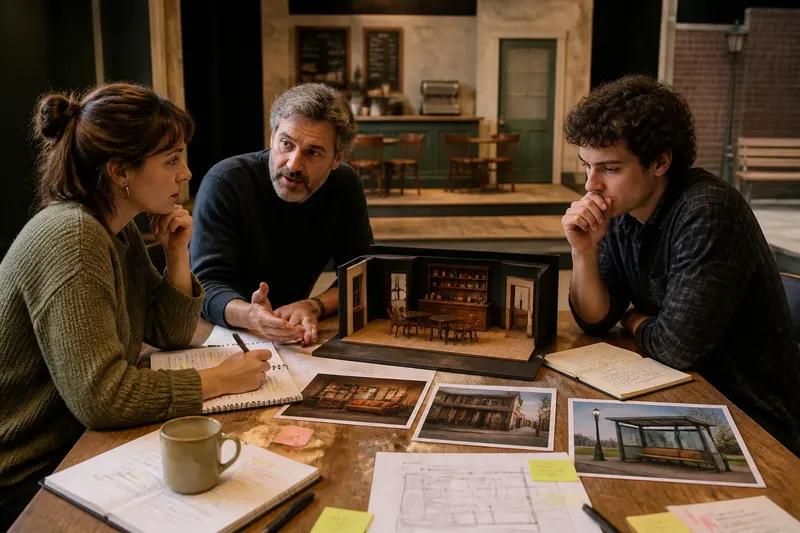
Say a community theatre is considering a script that moves between a flat, a café and a bus shelter. Imagine its director identifies the café as the only place where all the decisive conversations happen, while the flat and shelter mainly frame arrivals and departures. The production could retain a café-like core and use a chair, a bag and shifts in actor focus to mark the other places; the observable result should be that the audience follows the changes without waiting for a full rebuild.
4. How often must the scene change?
Count transitions, not just locations. A play with several locations may group them into long scenes, while a play with only two places may alternate between them constantly. Frequent changes can interrupt momentum, create backstage traffic and require actors or crew to work in view. Those demands matter even when the scenery is light.
For each transition, ask what the audience should experience: a pause, a jolt, a passage of time or no interruption at all. A blackout can hide a change, but it also asks the audience to wait. A visible rearrangement can preserve the pace, provided the movement has a clear rhythm and does not obscure a line the audience needs.
Mark transitions in the script and read them aloud in sequence. Note where the audience might lose track of time, relationships or the reason for the next scene. This is not a substitute for trying the material in the room; it is a way to spot whether a script’s location pattern suits the production’s available hands and rehearsal time.
5. What can the cast transform without losing focus?
In a small production, actors may carry scenery, change a few objects or signal a new place through movement. These choices can make transitions part of the performance rather than a pause between performances. They also compete for attention. If the cast is moving a heavy table while delivering an important speech, the audience may admire the table’s journey and miss the speech.
Decide whether performers are meant to represent the world, maintain it or change it. A script that permits direct address or visible scene shifts may make actor-led transformation feel natural. A tightly realistic drama may depend on uninterrupted attention to private behaviour, making conspicuous changes harder to absorb.
Keep the proposed movement proportionate to its dramatic value. A chair slid into a new position can mark a shift from courtroom to waiting room; a sequence of furniture rearrangements may turn every scene into a small loading exercise. The useful question is not whether actors can move the objects, but whether the movement helps the audience understand the moment.
6. What should a small production compare before choosing?
Use a short comparison rather than deciding from a set sketch alone. The same script can look manageable on paper and become cumbersome once entrances, actors and transitions are considered together. For each option, record the scene’s purpose, the visual cue that establishes the place and the work required to move between locations.
- Location count: List the places the audience must recognise, not every place mentioned in dialogue.
- Transition frequency: Mark each change in the script and note whether it can happen in view.
- Essential features: Identify what the location contributes to the action, such as privacy, confinement or a visible entrance.
- Actor traffic: Check whether performers can enter, exit and reposition objects without crossing a key moment.
- Audience cues: Name the light, object, movement or sound that will distinguish each place.
- Available crew: Consider who can manage a change while the cast is occupied, and whether the arrangement depends on one person doing two things at once.
Use the comparison to choose the smallest scenic language that remains clear, not the smallest set by default. If one location needs several special cues and repeated furniture changes, it may be more demanding than two places distinguished by simple, consistent signs.
7. What questions help settle the choice?
Can several locations be suggested by lighting alone?
Sometimes. A clear lighting shift can separate places when the stage picture remains readable and the audience understands the convention. If the distinction depends on a detail light cannot establish, add a physical cue or retain separate playing areas.
Does a single set always make a play easier?
No. It reduces some scenic changes, but may require careful blocking, convincing reasons for characters to share a space and a consistent way to signal changes in time or place. A fixed set is an artistic decision, not a waiver from solving the script’s practical problems.
How can a script with many locations be staged on a bare platform?
Choose a small number of repeatable signs, such as a bench for public spaces and a table for private ones, and use them consistently. Establish the convention early so the audience learns to read the actors’ arrangement and movement rather than waiting for a new backdrop.
When should a production keep distinct settings?
Keep them distinct when the location changes what characters can do, what the audience knows or how a scene feels. If collapsing the places would remove an obstacle or blur a crucial relationship, the extra transition may be the price of telling the play clearly.
How should the final choice serve the play?
Choose the arrangement that lets the audience follow the action with the least unnecessary explanation. A single adaptable setting can concentrate attention and make a modest production feel deliberate. Several distinct locations can give a play useful contrast and clarify how its characters move through the world. Neither is inherently more resourceful; the resourceful choice is the one whose demands match the script and the company.
Before settling, read one transition aloud with the proposed cue and actor movement, then ask someone who has not been involved in the decision what place they thought they were seeing. Their answer is not a verdict, but it may reveal a confusing signal while it is still easy to change. That small check is often more useful than drawing another elaborate set that the play never asked for.